2.19.2009

The five-second rule

The five-second rule you ask? What in the world does the five-second rule have to do with food? Everything! The five-second rule is the end-all be-all that determines whether or not one can go on devouring whatever it is that sits on his or her plate. The five-second rule--ingrained into our minds since childhood--is the one thing that saves us from having to admit clumsiness, having to get up from the table to get a new eating utensil, having to endure a speed-bump interruption of the satisfying act of dining...

This evening I attended an event for a culinary organization I belong to, the Portland Culinary Alliance. Though a fun time mingling and getting to know the myriad of acquaintances in attendance a bit better, the eating of food and sipping of libations was, at times, sort of a challenge. At one point in the evening I was sitting with a sparkling wine glass in one hand and an appetizer plate on my lap when one of my new most favorite people was chatting with a couple sitting next to me. It was Cole Danehower, Co-Publisher and Wine Editor of Northwest Palate magazine. Cole is the type of person who one meets and instantly wants to become best friends with. He's incredibly knowledgeable about all things wine, humble and just an all around fun guy to be around. Am I gushing? I told myself I wouldn't gush. Honestly, I have been around Cole more than once and I really do want to be his new best friend. Am I reaching stalker level? Ok. I'll stop. Anyway, back to drink in hand and plate on lap...

In the mist of attempting to juggle the contents in my hand and lap, my fork slid gracefully off of my appetizer plate and onto the floor between my black-heeled boots. I quickly leaned forward and remarked, "Oh! Five-second rule!" And you know what? My new best friend defended me. Not only was Cole gracious enough to assure me I wasn't completely nuts in regards to the the five-second rule, he proceeded to tell me that there was actually a study done not long ago that proved the five-second rule to be--pretty much--true! According to Cole, the study reported that five seconds is about the longest amount of time an item can remain on the floor until a harmful amount of bacteria accumulates on it. Five second or less, you're good with a light rub against a napkin.

Upon arriving home I had to check this out. I Googled "Five-second rule" and sure enough, I received a few links that discussed the claim. One happened to support it, the other was a bit more cautious.

According to a study discussed briefly in The Boston Globe in May 2007, students at Connecticut College conducted research involving the dropping of food and whether or not it could pick up the "rogue" bacteria. I'm not for certain why they chose to focus in on rogue bacteria, but that was the bacteria of choice for these researchers. They came to the conclusion that patrons could actually wait as long as 30 second, pick something up off the floor and still eat it without obtaining harmful bacteria. Now even I think 30 seconds is a bit too long, my friends. Five seconds, ok, but 30? Yikes.

The second study I came across was posted in The New York Times, also in May of 2007 and written by Harold McGee. His article referred to a study done by Clemson University. This study was a bit more conservative and basically stated that harmful microbes are all around us; on the ground, on our tray tables on the airplane, in the air. The conclusion of the article was more of use your own judgment, but rest assured you'll be inputting some type of bacteria into your mouth!

The five-second rule. Who hasn't come across it? It's just a part of our dining culture don't you think?

Keep enjoying those good eats, just try to wax the floor beforehand!

Cheers,
~JF

2.17.2009

A pre-book review: Hometown Appetites

It was about two years ago that I began my love for great food writing. It started with Julie Powell, then led to Ruth Reichl, M.F.K. Fisher, Anthony Bourdain and so on. The list of food writing talent out in the world today is truly endless. I've always enjoyed great writing, and that combined with the ability to take something as simple as food and transform it into an entertaining piece of prose that relates its most minute details into our everyday lives is so fascinating to me. It's what brought me here, to this page, to this blog, to this life I so wish to achieve.

Needless to say, I was overjoyed when I received an incredibly sincere Christmas gift from my sister and her boyfriend this past holiday. It was a book called Hometown Appetites: The Story of Clementine Paddleford, the Forgotten Food Writer Who Chronicled How America Ate. I was ecstatic! Another gastronomic lit book to dive into! But I will totally admit that my immediate thought post excitement of receiving the book was, "Who the heck is Clementine Paddleford??" How could I? An aspiring food writer and lover and eager student of all things culinary not knowing one of the most famed food writers to have ever set pen to paper? For shame! Well, come to find out I wasn't the only one. It seems poor Ms. Paddleford somehow got pushed aside amongst the swarm of up-and-coming food writers to take shape in the U.S. But I for one believe in searching out the forgotten and bringing forth a rebirth...or a comeback. Ms. Paddelford passed away in 1967, but that doesn't mean her spirit and talent she delivered can't still be known and discovered today.

I haven't dove too far into the book thus far, but can provide a recap of what lies ahead in its contents...

Clementine Paddleford is said to be the first food writer who truly captured and defined American cuisine. Her travels took her to just about every imaginable spot across our great USofA. She was a columnist for the New York Herald Tribune and This Week magazine and enjoyed a successful career that spanned from the 1920s to the 1960s. She wrote to an audience that grew to 12 million readers a week, and in 1953, Time magazine named her the country's "Best-Known Food Editor." And my favorite part-or what I'm looking most forward to reading-she is said to have written 'smartly, sassily, and with unerring enthusiasm about the pleasures of regional American food.' Emphasis on the smartly, sassily part.

A quote from Clementine Paddleford from the book:
"I have ranged from the lobster pots of Maine to the vineyards of California, from the sugar shanties of Vermont to the salmon canneries in Alaska. I have eaten with crews on fishing boats and enjoyed slumgullion at a Hobo Convention. [I've]chawed on cuts of fresh sugarcane in Louisiana, and eaten roasted young goat in San Antonio and roasted fresh truffles flown in from Italy at the Four Seasons in New York."

In just that one paragraph you seem to have explored quite a life in food, Ms. Paddleford. I'm salivating and looking forward to diving in, reading and taking in the amazing life you lived.

Cheers,
~JF

2.15.2009

2009 List of Culinary Trends

I recently came across this press release from Epicurious.com. Epicurious comes out with an annual list of what it predicts to be the coming culinary trends for the new year. It was released in December so I'm a bit late, nonetheless I thought it was a fun read to see if the culinary online publication's predictions were on so far. What do you think?

And eh hem, Portland, Maine the new Portland, Oregon. I don't think so! There is only one Portland in this USofA!

Epicurious.com Releases Annual List of Culinary Trend Predictions and Reflections
NEW YORK, Dec. 2 /PRNewswire/ -- Push the Thai menu aside, and make way for Peruvian food. Epicurious.com, the premier award-winning food site, has released its annual list of food trend predictions for 2009. Epicurious.com editors think you'll make more dining decisions based on value, see noodle shops open alongside sushi restaurants, and notice a surge in smoked flavors as opposed to fried.

Epicurious.com makes the following culinary predictions for 2009:
-- Peruvian is the new Thai: You thought Peruvian cuisine was all about seviche, maybe? Guess again: Peru boasts culinary influences from Spanish, Basque, African, Cantonese, Japanese, Italian, French,and British immigrants. Pisco Sour, anyone?

-- Noodle Bars are the new Sushi Joints: With some seafood being suspect or overfished and raw fish prices high, noodles make complete sense. If there's no ramen, udon, or soba shop in your neck of the woods,there probably will be soon.

-- "Value" is the new "Sustainable": These days,the economy dictates our cooking and shopping decisions. Bargains are in,no matter where they come from.

-- Ginger is the new Mint: Move over, mojitos. Ginger beers and ginger cocktails (like the Ginger Rogers, Gin-Mule, and Ginger Smash)are bubbling up at places like the Violet Hour in Chicago, the Clock Bar in San Francisco, and Matsugen in New York.

-- Smoking is the new Frying: You know how everything tastes better fried? Well, almost everything tastes better smoked, too, and that includes cocktails. Bartenders (Eben Freeman at Tailor in New York, for example)are smoking their bourbons, and chefs, recognizing the national craze for BBQ flavor, are smoking more than just salmon and ribs: nuts, salts,even smoked steelhead roe (at Chicago's Alinea). Who says smoking's bad for you?

-- Regional Roasters are the new Starbucks: It's come full circle. What started as a local coffee phenomenon migrated to other cities and turned Americans into java junkies. Then the chain overexpanded, and the little neighborhood coffee roasters thrive again, like Stumptown (Portland,Oregon), Blue Bottle (San Francisco), and La Colombe (Philadelphia).

-- Portland (Maine) is the new Portland (Oregon): Abundance of great chefs, restaurants, and local foodies? Check, check, and check. Want examples? Visit Five Fifty-Five, Hugo's, and Fore Street to start.

-- Rustic Food is the new Molecular Gastronomy: Wacky weird-science cuisine that requires fancy-schmancy equipment doesn't necessarily make food taste better, and more often than not it adds needless complexity (there are exceptions). Most importantly, no one really wants to do this at home. Expect to see comfort food stage a comeback again.

-- "Top-Rated" is the new "Critic's Pick": Power to the people; single critics are a dying breed. Why believe what one person says when you can read and reflect on what hundreds think?

For a complete list of the best food trends this year, log on to: http://tinyurl.com/5u2udn.

Epicurious.com, a CondeNet site, is an award-winning food Web site that incorporates more than 35,000 professionally tested recipes from the premier brands in food journalism, 50,000 member-submitted recipes, and Web-exclusive original content from Epicurious.com editors and leading food authorities around the world. Epicurious offers a wealth of articles and tips focused on cooking, entertaining, wine, cocktails, and shopping.

CONTACT: Allison Braley (212)790-4487 allison_braley@condenast.com Epicurious.com
CONTACT: Allison Braley, +1-212-790-4487, allison_braley@condenast.com

Web site:http://www.Epicurious.com.

2.14.2009

Going Home

A move in 1981 brought me and my family from southern California to a little town about 26 miles south of Portland called Canby. I did pretty much all of my growing up there, and although I live closer to the rose city these days, my parents are still there. And, of course, as any loved, adored, perfect child, I hardly ever venture out to visit them. Oops.

A scheduled trip to my doctor on Friday had me staying at my parents' for a couple of nights this weekend. It's always nice to go home no matter how far away you are from the parental unit as it's so simple to step right in and feel so immediately comfortable. The other thing about going back home? Some good old comfort food. And not just the over-the-top, highly fattening, overindulgence kind, but the familiar brands and packaged goods that you only see when you go home.
I always get a kick out of discovering certain products in the house that I don't necessarily buy now, but remind me of when I used to live there with them: Yoplait yogurt, Pringles(R), Welch's grape juice (one of my favorites!), Cambell's Chicken Noodle Soup and Nilla Wafer cookies.

To make my first night with them totally complete, my mom sealed off a home-cooked meal of chicken, rice and corn on Friday night with one of the best childhood desserts ever, one that is so incredibly simple to make and that we all love still today; banana pudding with Nilla Wafers. Yay!

I helped my mom put the batch together as the kitchen began smelling like warm, vanilla pudding. The dish takes just four simple ingredients: milk, Jello Cook & Serve Vanilla Pudding, Nilla Wafer cookies and about four bananas.

She takes one 4.5 ounce box of Cook & Serve Jello Vanilla Pudding and cooks it on the stove as as per the directions on the box (stirring it in three cups of milk until the mixture comes to a boil).
While the pudding cooks on the stove, she begins to fill a large ramekin bowl with the contents that make up the yummy bites within. She first covers the bottom of the bowl with a good layer of the wafers.
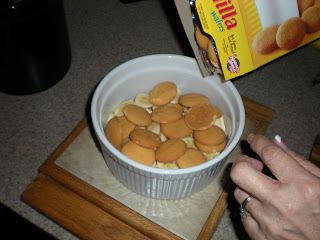
Then a layer of sliced banana.

Then another layer of wafers and so on until she reaches to top of the bowl. By this time the pudding is complete on the stove and it's time to to pour over the bananas and wafers. Once all the pudding has been poured in she'll shake the bowl slightly just to ensure all the pudding gets through the layers of banana and wafers and makes it to the bottom. She'll then take a few wafers, crush them and sprinkle them on top. This gives the dish it's attractive little presentation.
The dish can be eaten warm as the pudding cools slightly or refrigerated, we all like it still warm-the flavor of the vanilla is still so prominent then.

As always, the dessert was perfect, and hanging out with the parents for a couple of days delivered a few laughs as well.

Some random pictures from home. I couldn't resist...


Little me and my mom


Little me and my dad
It's always fun to go home.
Cheers,
~JF


1.31.2009

Tidbits on the Oregon Truffle

On Friday evening I had the pleasure of dining with a good friend at one of North Portland's most prized new culinary hot spots; Lincoln Restaurant. Our choice of libations and delectable eats made for a memorable and scrumptious evening. But the one item that continued to stay on my mind throughout the night and into the next day was the white Oregon truffle. Served shaved and sprinkled over a caramelized onion tart with a small arugula salad and pecorino cheese, the truffle shavings were a nice surprise to the dish. The salty/garlicky flavor was an absolute treat for my taste buds.

But what kept me thinking about the truffles were their local quality. First of all, truffles are the fruiting bodies of a species in the genus Tuber of the mushroom family. Possibly the most well known spot for the cultivation of truffles is in France, with Italy most likely a close second. Let's hear it for the Pacific Northwest, specifically Oregon. With its climate that is known to be similar to that of France (which also delivers to us some fantastic grapes: think Oregon Pinot Noir/French Burgundy), Oregon might well be the most nascent location for the cultivation for truffles outside of Europe.

In fact, the weekend of having Oregon truffles on my mind was serendipitous. This weekend in Oregon marked the Fourth Annual Oregon Truffle Festival. Hosted in and around the Eugene area, the Oregon Truffle Festival is held in celebration of the Oregon truffle as it reaches its peak ripening season. The festival is the first of its kind in North America and attracts chefs, growers, truffle harvesters and culinary aficionados from all over the region to share in their love for the highly sought-after fungus.

White Oregon truffle shavings
Photo courtesy of John Valls from the Oregon Truffle Festival website

I was a bit behind in learning about the truffle fest this weekend, but was intrigued to continue digging in to a little more research about them. From one of my most trusted culinary resources, On Food and Cooking by Harold McGee:

They're typically a dense, knobby mass, ranging from walnut- to fist-sized or larger. Unlike mushrooms, truffles remain hidden underground. They spread their spores by emitting a scent to attract animals-including beetles, squirrels, rabbits, and deer-which find and eat them and spread the spores in their dung. This is why truffles have a musky, persistent aroma-to attract their spore spreaders-and why they're still gathered with the help of trained dogs or pigs...

Don't let the spores/dungs/spreaders/etc. scare you! The truffles truly are a delicacy when lightly incorporated into the right dish.

More from McGee:
The flavors of black and white truffles are quite distinct. Black truffles are relatively subtle and earthy...white truffles have a stronger, pungent, somewhat garlicky aroma thanks to a number of unusual sulfur compounds. The flavor of black truffles is generally thought to be enhanced by gentle cooking, while the flavor of white truffles, though strong, is fragile, and best enjoyed by shaving paper-thin slices onto a dish (like the one I had!) just before service.

Because of their high cost, truffles are used sparingly. White truffles are generally served raw and shaved over pasta or salads. White or black truffles may also be shaved thin and inserted into meats or underneath the skin of poultry. As a way to add the flavor of truffles without the steep cost, truffle oil is often used in many gourmet dishes.

To learn a bit more about Oregon truffles and even information on the 2010 Oregon Truffle Festival, visit: http://www.oregontrufflefestival.com/tickets.html.

Cheers,
~JF


Related Posts Plugin for WordPress, Blogger...