I recently came across this press release from Epicurious.com. Epicurious comes out with an annual list of what it predicts to be the coming culinary trends for the new year. It was released in December so I'm a bit late, nonetheless I thought it was a fun read to see if the culinary online publication's predictions were on so far. What do you think?
And eh hem, Portland, Maine the new Portland, Oregon. I don't think so! There is only one Portland in this USofA!
Epicurious.com Releases Annual List of Culinary Trend Predictions and Reflections
NEW YORK, Dec. 2 /PRNewswire/ -- Push the Thai menu aside, and make way for Peruvian food. Epicurious.com, the premier award-winning food site, has released its annual list of food trend predictions for 2009. Epicurious.com editors think you'll make more dining decisions based on value, see noodle shops open alongside sushi restaurants, and notice a surge in smoked flavors as opposed to fried.
Epicurious.com makes the following culinary predictions for 2009:
-- Peruvian is the new Thai: You thought Peruvian cuisine was all about seviche, maybe? Guess again: Peru boasts culinary influences from Spanish, Basque, African, Cantonese, Japanese, Italian, French,and British immigrants. Pisco Sour, anyone?
-- Noodle Bars are the new Sushi Joints: With some seafood being suspect or overfished and raw fish prices high, noodles make complete sense. If there's no ramen, udon, or soba shop in your neck of the woods,there probably will be soon.
-- "Value" is the new "Sustainable": These days,the economy dictates our cooking and shopping decisions. Bargains are in,no matter where they come from.
-- Ginger is the new Mint: Move over, mojitos. Ginger beers and ginger cocktails (like the Ginger Rogers, Gin-Mule, and Ginger Smash)are bubbling up at places like the Violet Hour in Chicago, the Clock Bar in San Francisco, and Matsugen in New York.
-- Smoking is the new Frying: You know how everything tastes better fried? Well, almost everything tastes better smoked, too, and that includes cocktails. Bartenders (Eben Freeman at Tailor in New York, for example)are smoking their bourbons, and chefs, recognizing the national craze for BBQ flavor, are smoking more than just salmon and ribs: nuts, salts,even smoked steelhead roe (at Chicago's Alinea). Who says smoking's bad for you?
-- Regional Roasters are the new Starbucks: It's come full circle. What started as a local coffee phenomenon migrated to other cities and turned Americans into java junkies. Then the chain overexpanded, and the little neighborhood coffee roasters thrive again, like Stumptown (Portland,Oregon), Blue Bottle (San Francisco), and La Colombe (Philadelphia).
-- Portland (Maine) is the new Portland (Oregon): Abundance of great chefs, restaurants, and local foodies? Check, check, and check. Want examples? Visit Five Fifty-Five, Hugo's, and Fore Street to start.
-- Rustic Food is the new Molecular Gastronomy: Wacky weird-science cuisine that requires fancy-schmancy equipment doesn't necessarily make food taste better, and more often than not it adds needless complexity (there are exceptions). Most importantly, no one really wants to do this at home. Expect to see comfort food stage a comeback again.
-- "Top-Rated" is the new "Critic's Pick": Power to the people; single critics are a dying breed. Why believe what one person says when you can read and reflect on what hundreds think?
For a complete list of the best food trends this year, log on to: http://tinyurl.com/5u2udn.
Epicurious.com, a CondeNet site, is an award-winning food Web site that incorporates more than 35,000 professionally tested recipes from the premier brands in food journalism, 50,000 member-submitted recipes, and Web-exclusive original content from Epicurious.com editors and leading food authorities around the world. Epicurious offers a wealth of articles and tips focused on cooking, entertaining, wine, cocktails, and shopping.
CONTACT: Allison Braley (212)790-4487 allison_braley@condenast.com Epicurious.com
CONTACT: Allison Braley, +1-212-790-4487, allison_braley@condenast.com
Web site:http://www.Epicurious.com.
2.15.2009


2.14.2009
Going Home
A move in 1981 brought me and my family from southern California to a little town about 26 miles south of Portland called Canby. I did pretty much all of my growing up there, and although I live closer to the rose city these days, my parents are still there. And, of course, as any loved, adored, perfect child, I hardly ever venture out to visit them. Oops.
 While the pudding cooks on the stove, she begins to fill a large ramekin bowl with the contents that make up the yummy bites within. She first covers the bottom of the bowl with a good layer of the wafers.
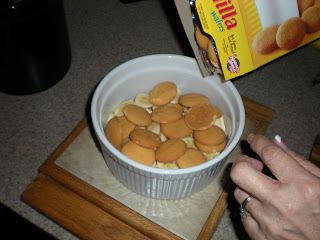 Then a layer of sliced banana.
 Then another layer of wafers and so on until she reaches to top of the bowl. By this time the pudding is complete on the stove and it's time to to pour over the bananas and wafers.
  Once all the pudding has been poured in she'll shake the bowl slightly just to ensure all the pudding gets through the layers of banana and wafers and makes it to the bottom. She'll then take a few wafers, crush them and sprinkle them on top. This gives the dish it's attractive little presentation.
 The dish can be eaten warm as the pudding cools slightly or refrigerated, we all like it still warm-the flavor of the vanilla is still so prominent then.
 Little me and my mom
 Little me and my dad
A scheduled trip to my doctor on Friday had me staying at my parents' for a couple of nights this weekend. It's always nice to go home no matter how far away you are from the parental unit as it's so simple to step right in and feel so immediately comfortable. The other thing about going back home? Some good old comfort food. And not just the over-the-top, highly fattening, overindulgence kind, but the familiar brands and packaged goods that you only see when you go home.
I always get a kick out of discovering certain products in the house that I don't necessarily buy now, but remind me of when I used to live there with them: Yoplait yogurt, Pringles(R), Welch's grape juice (one of my favorites!), Cambell's Chicken Noodle Soup and Nilla Wafer cookies.
To make my first night with them totally complete, my mom sealed off a home-cooked meal of chicken, rice and corn on Friday night with one of the best childhood desserts ever, one that is so incredibly simple to make and that we all love still today; banana pudding with Nilla Wafers. Yay!
I helped my mom put the batch together as the kitchen began smelling like warm, vanilla pudding. The dish takes just four simple ingredients: milk, Jello Cook & Serve Vanilla Pudding, Nilla Wafer cookies and about four bananas.
She takes one 4.5 ounce box of Cook & Serve Jello Vanilla Pudding and cooks it on the stove as as per the directions on the box (stirring it in three cups of milk until the mixture comes to a boil).
While the pudding cooks on the stove, she begins to fill a large ramekin bowl with the contents that make up the yummy bites within. She first covers the bottom of the bowl with a good layer of the wafers.Then a layer of sliced banana.Then another layer of wafers and so on until she reaches to top of the bowl. By this time the pudding is complete on the stove and it's time to to pour over the bananas and wafers. Once all the pudding has been poured in she'll shake the bowl slightly just to ensure all the pudding gets through the layers of banana and wafers and makes it to the bottom. She'll then take a few wafers, crush them and sprinkle them on top. This gives the dish it's attractive little presentation.The dish can be eaten warm as the pudding cools slightly or refrigerated, we all like it still warm-the flavor of the vanilla is still so prominent then. As always, the dessert was perfect, and hanging out with the parents for a couple of days delivered a few laughs as well.
Some random pictures from home. I couldn't resist...
Little me and my momLittle me and my dadIt's always fun to go home.
Cheers,
~JF
1.31.2009
Tidbits on the Oregon Truffle
On Friday evening I had the pleasure of dining with a good friend at one of North Portland's most prized new culinary hot spots; Lincoln Restaurant. Our choice of libations and delectable eats made for a memorable and scrumptious evening. But the one item that continued to stay on my mind throughout the night and into the next day was the white Oregon truffle. Served shaved and sprinkled over a caramelized onion tart with a small arugula salad and pecorino cheese, the truffle shavings were a nice surprise to the dish. The salty/garlicky flavor was an absolute treat for my taste buds.
But what kept me thinking about the truffles were their local quality. First of all, truffles are the fruiting bodies of a species in the genus Tuber of the mushroom family. Possibly the most well known spot for the cultivation of truffles is in France, with Italy most likely a close second. Let's hear it for the Pacific Northwest, specifically Oregon. With its climate that is known to be similar to that of France (which also delivers to us some fantastic grapes: think Oregon Pinot Noir/French Burgundy), Oregon might well be the most nascent location for the cultivation for truffles outside of Europe.
In fact, the weekend of having Oregon truffles on my mind was serendipitous. This weekend in Oregon marked the Fourth Annual Oregon Truffle Festival. Hosted in and around the Eugene area, the Oregon Truffle Festival is held in celebration of the Oregon truffle as it reaches its peak ripening season. The festival is the first of its kind in North America and attracts chefs, growers, truffle harvesters and culinary aficionados from all over the region to share in their love for the highly sought-after fungus.
 White Oregon truffle shavings
Photo courtesy of John Valls from the Oregon Truffle Festival website
I was a bit behind in learning about the truffle fest this weekend, but was intrigued to continue digging in to a little more research about them. From one of my most trusted culinary resources, On Food and Cooking by Harold McGee:
They're typically a dense, knobby mass, ranging from walnut- to fist-sized or larger. Unlike mushrooms, truffles remain hidden underground. They spread their spores by emitting a scent to attract animals-including beetles, squirrels, rabbits, and deer-which find and eat them and spread the spores in their dung. This is why truffles have a musky, persistent aroma-to attract their spore spreaders-and why they're still gathered with the help of trained dogs or pigs...
Don't let the spores/dungs/spreaders/etc. scare you! The truffles truly are a delicacy when lightly incorporated into the right dish.
More from McGee:
The flavors of black and white truffles are quite distinct. Black truffles are relatively subtle and earthy...white truffles have a stronger, pungent, somewhat garlicky aroma thanks to a number of unusual sulfur compounds. The flavor of black truffles is generally thought to be enhanced by gentle cooking, while the flavor of white truffles, though strong, is fragile, and best enjoyed by shaving paper-thin slices onto a dish (like the one I had!) just before service.
Because of their high cost, truffles are used sparingly. White truffles are generally served raw and shaved over pasta or salads. White or black truffles may also be shaved thin and inserted into meats or underneath the skin of poultry. As a way to add the flavor of truffles without the steep cost, truffle oil is often used in many gourmet dishes.
To learn a bit more about Oregon truffles and even information on the 2010 Oregon Truffle Festival, visit: http://www.oregontrufflefestival.com/tickets.html.
Cheers,
~JF
But what kept me thinking about the truffles were their local quality. First of all, truffles are the fruiting bodies of a species in the genus Tuber of the mushroom family. Possibly the most well known spot for the cultivation of truffles is in France, with Italy most likely a close second. Let's hear it for the Pacific Northwest, specifically Oregon. With its climate that is known to be similar to that of France (which also delivers to us some fantastic grapes: think Oregon Pinot Noir/French Burgundy), Oregon might well be the most nascent location for the cultivation for truffles outside of Europe.
In fact, the weekend of having Oregon truffles on my mind was serendipitous. This weekend in Oregon marked the Fourth Annual Oregon Truffle Festival. Hosted in and around the Eugene area, the Oregon Truffle Festival is held in celebration of the Oregon truffle as it reaches its peak ripening season. The festival is the first of its kind in North America and attracts chefs, growers, truffle harvesters and culinary aficionados from all over the region to share in their love for the highly sought-after fungus.
 White Oregon truffle shavings
Photo courtesy of John Valls from the Oregon Truffle Festival website
I was a bit behind in learning about the truffle fest this weekend, but was intrigued to continue digging in to a little more research about them. From one of my most trusted culinary resources, On Food and Cooking by Harold McGee:
They're typically a dense, knobby mass, ranging from walnut- to fist-sized or larger. Unlike mushrooms, truffles remain hidden underground. They spread their spores by emitting a scent to attract animals-including beetles, squirrels, rabbits, and deer-which find and eat them and spread the spores in their dung. This is why truffles have a musky, persistent aroma-to attract their spore spreaders-and why they're still gathered with the help of trained dogs or pigs...
Don't let the spores/dungs/spreaders/etc. scare you! The truffles truly are a delicacy when lightly incorporated into the right dish.
More from McGee:
The flavors of black and white truffles are quite distinct. Black truffles are relatively subtle and earthy...white truffles have a stronger, pungent, somewhat garlicky aroma thanks to a number of unusual sulfur compounds. The flavor of black truffles is generally thought to be enhanced by gentle cooking, while the flavor of white truffles, though strong, is fragile, and best enjoyed by shaving paper-thin slices onto a dish (like the one I had!) just before service.
Because of their high cost, truffles are used sparingly. White truffles are generally served raw and shaved over pasta or salads. White or black truffles may also be shaved thin and inserted into meats or underneath the skin of poultry. As a way to add the flavor of truffles without the steep cost, truffle oil is often used in many gourmet dishes.
To learn a bit more about Oregon truffles and even information on the 2010 Oregon Truffle Festival, visit: http://www.oregontrufflefestival.com/tickets.html.
Cheers,
~JF
1.29.2009
Cutting Mangoes
There's a place close to my office where I venture to often to grab a fresh salad and a side of fruit. The place is called Salad World and I remember one day, not too long ago, when I included some fresh chunks of mango in my little fruit cup.
The flavor was amazing. And the texture? The most perfect ever. I've always had a tough time purchasing perfect mangoes. For me they're usually too hard and a bit more on the bitter side than I'd prefer. I've even tried allowing them to develop for a few extra days in a paper bag on the counter: still no luck.
My other challenge with mangoes? Cutting them. Every time I place a mango on a cutting board and reach for my chef's knife, my mind is suddenly taken back to chef Tina's International Cuisine class where she showed me, and I'm sure more than once, how to successfully cut up a mango. I was baffled, as were many of my peers in class. Do you peel the outside first? I tried to slice through with my knife, but it gets stuck in the middle. Chaos. And even to this day, I continue to consider it a roadblock. Apparently her excellent instructions did not stick to my poor memory.
The other day I asked my fellow Facebook friends how they cut up a mango. I received a few responses from some good friends which led me to believe that I could soon be on to successful cutting of the one mango I had sitting on my kitchen counter.
Angela confessed right away: "I get the frozen chunks from Costco. Lazy, huh?"
Well, not totally. I responded by saying I too often purchase a bag of the frozen cubes for my morning protein shakes.
Martin added in: "Start by peeling the outside with a potato peeler, works every time."
Carrie chimed: "I cut them in half, cut the yummy insides in a checker board pattern, push on the outside skin to pop it inside out and cut off the chunks."
Ok, that just sounds absolutely logical and way too easy!
Denise supported Carrie's system, but said she cuts hers: "In thirds."
But how do they cut all the way through? That is my big problem. Denise said by using a bigger or sharper knife or giving it an extra day or two of ripening.
Well ok then. I was ready to go.

So I took my mango and placed it on the cutting board. I grabbed my chef's knife and introduced the two. And away I cut. I will be honest, I think this mango actually sat a little too long, but that means it should have been easier to cut, right? Not so my friends.
 Honest, I tried with all my might, but there was no way that knife was getting through. Is it not sharp enough? That would be a disgrace! Did I not allow it to mature in its brown paper bag long enough? The skin was beginning to wrinkle, how much longer did it need?
 I didn't spend too much time and energy trying to cut through and carve out perfect-looking orange cubes, but instead went my normal route: I stand mine on it's head and run my knife in a curving motion from top to bottom. Similar to how some might peel an apple I guess. This delivers longer slices versus cubes.
In any case it was absolutely delicious; almost up to snuff with Salad World's amazing mangoes.
So as my case has always been to be on an exploration of the culinary world I will happily add mangoes to my list for both finding those which are perfectly ripe, as well as playing around with the best ways to dive in a savor the gorgeous fruit.
Let the adventures and exploration continue.
Cheers,
~JF
The flavor was amazing. And the texture? The most perfect ever. I've always had a tough time purchasing perfect mangoes. For me they're usually too hard and a bit more on the bitter side than I'd prefer. I've even tried allowing them to develop for a few extra days in a paper bag on the counter: still no luck.
My other challenge with mangoes? Cutting them. Every time I place a mango on a cutting board and reach for my chef's knife, my mind is suddenly taken back to chef Tina's International Cuisine class where she showed me, and I'm sure more than once, how to successfully cut up a mango. I was baffled, as were many of my peers in class. Do you peel the outside first? I tried to slice through with my knife, but it gets stuck in the middle. Chaos. And even to this day, I continue to consider it a roadblock. Apparently her excellent instructions did not stick to my poor memory.
The other day I asked my fellow Facebook friends how they cut up a mango. I received a few responses from some good friends which led me to believe that I could soon be on to successful cutting of the one mango I had sitting on my kitchen counter.
Angela confessed right away: "I get the frozen chunks from Costco. Lazy, huh?"
Well, not totally. I responded by saying I too often purchase a bag of the frozen cubes for my morning protein shakes.
Martin added in: "Start by peeling the outside with a potato peeler, works every time."
Carrie chimed: "I cut them in half, cut the yummy insides in a checker board pattern, push on the outside skin to pop it inside out and cut off the chunks."
Ok, that just sounds absolutely logical and way too easy!
Denise supported Carrie's system, but said she cuts hers: "In thirds."
But how do they cut all the way through? That is my big problem. Denise said by using a bigger or sharper knife or giving it an extra day or two of ripening.
Well ok then. I was ready to go.

So I took my mango and placed it on the cutting board. I grabbed my chef's knife and introduced the two. And away I cut. I will be honest, I think this mango actually sat a little too long, but that means it should have been easier to cut, right? Not so my friends.
 Honest, I tried with all my might, but there was no way that knife was getting through. Is it not sharp enough? That would be a disgrace! Did I not allow it to mature in its brown paper bag long enough? The skin was beginning to wrinkle, how much longer did it need?
 I didn't spend too much time and energy trying to cut through and carve out perfect-looking orange cubes, but instead went my normal route: I stand mine on it's head and run my knife in a curving motion from top to bottom. Similar to how some might peel an apple I guess. This delivers longer slices versus cubes.
In any case it was absolutely delicious; almost up to snuff with Salad World's amazing mangoes.
So as my case has always been to be on an exploration of the culinary world I will happily add mangoes to my list for both finding those which are perfectly ripe, as well as playing around with the best ways to dive in a savor the gorgeous fruit.
Let the adventures and exploration continue.
Cheers,
~JF
12.21.2008
Oh the Weather Outside is Frightful...
I believe those words are the beginning of the lyrics. I never noticed the "frightful" in that song before. Though I don't know if we actually hit "frightful" today in Portland, we were pretty darn close. Most of us around the Rose City and it's metro areas have been snowed in for over a day now. The weathermen were finally spot-on and the arctic blast made its way to us this week, and particularly this weekend.
 A snow-drenched bush outside my front door
 Ice-covered branches outside the condo
 A snow-drenched bush outside my front door
  Ice-covered branches outside the condo
I will admit, however, that I was a bit disappointed today when I discovered that the gorgeous white powder hindered the delivery of my Sunday New York Times. I adore a slow Sunday morning with a cup of coffee from my new French press, a breakfast that takes more than three minutes to put together, a nice fire and the hefty paper waiting for me to flip through it's special sections. The paper was not with me today, but that didn't mean the coffee, breakfast and fireplace had to abandon the final day of my weekend.
As I'm back to working in what I refer to as the "real world" I usually don't make a real breakfast in the morning during the weekday. So when the weekend comes, especially Sundays, I do like to take some time to put something together that I can enjoy with more than a little time to spare. And for a day like today, with eight inches of snow on the ground and the sky delivering even more showers from the sky, I got the hunkering for a bowl of slow-cooked steel cut oats, or Irish oatmeal, to go alongside my French press cup of Jo.
 French press and steel-cut oats ready to go!
Though they take a little while to cook, I think making the slow-cooked oatmeal is well worth it, and it's so simple. Bring 3 cups of water to a boil, add about 1/4 teaspoon of kosher salt and 1 cup of dried oats.


As I'm back to working in what I refer to as the "real world" I usually don't make a real breakfast in the morning during the weekday. So when the weekend comes, especially Sundays, I do like to take some time to put something together that I can enjoy with more than a little time to spare. And for a day like today, with eight inches of snow on the ground and the sky delivering even more showers from the sky, I got the hunkering for a bowl of slow-cooked steel cut oats, or Irish oatmeal, to go alongside my French press cup of Jo.
 French press and steel-cut oats ready to go!
Though they take a little while to cook, I think making the slow-cooked oatmeal is well worth it, and it's so simple. Bring 3 cups of water to a boil, add about 1/4 teaspoon of kosher salt and 1 cup of dried oats.


Oats cooking away!
Once the oats are added to the boiling water, just turn the burner down to low and let the mixture simmer for about 20-25 minutes. As the oats absorb the boiling water, one thing I like to do is add about 1 tablespoon of good vanilla extract to the mixture to give it some flavor. This, in turn, gives the kitchen and the entire condo a cozy aroma as well.
Once my oats are ready to eat, I'll usually add some ground cinnamon, dried cranberries or dried, chopped dates sprinkled on top. For some reason I was out of dates and cranberries today, but found a few yummy substitues that I think brought the bowl of goods to a delicious surprise.

My final product: oats sprinkled with pecans, a little cinnamon and a dollop of rasberry preserves
Once my oats are ready to eat, I'll usually add some ground cinnamon, dried cranberries or dried, chopped dates sprinkled on top. For some reason I was out of dates and cranberries today, but found a few yummy substitues that I think brought the bowl of goods to a delicious surprise.

My final product: oats sprinkled with pecans, a little cinnamon and a dollop of rasberry preserves
My warm oats and fresh French press beverage kept me warm all day through the 21 degree weather in Portland today.
When the weather outside is frightful, what do you prefer to enjoy in your bowl to cozy up with? Whatever it may be, I hope it carries you through a marvelous holiday!
Cheers,
~JF
When the weather outside is frightful, what do you prefer to enjoy in your bowl to cozy up with? Whatever it may be, I hope it carries you through a marvelous holiday!
Cheers,
~JF
Subscribe to:
Posts (Atom)
